
If you are still thinking of restaurant food delivery as an “add-on,” 2026 has probably already proven you wrong.
What started years ago as a convenience channel has turned into something much bigger. For many restaurants, delivery is not just supporting revenue. It is driving it. And interestingly, this growth has continued even after dine-in traffic stabilized.
Consumer spending on food delivery is expected to push industry sales to a projected $1.55T nationwide across the US.
That is what makes this moment different.
Restaurant food delivery is no longer reactive. It is habitual. And the numbers are pointing in the same direction.
The Market Is Bigger Than Most Expected
Even after the initial surge years back, analysts expected delivery to level out. It did not. Instead, spending continued climbing, just at a more stable and sustainable pace.
In the United States, digital ordering now represents a meaningful portion of total restaurant revenue across quick service and fast casual segments. Globally, the delivery market continues expanding, supported by increased order frequency rather than just new users signing up.
That detail matters.
Growth today is not coming from curiosity. It is coming from repeat behavior. People are ordering more often, not just trying it out.
Average ticket sizes also remain higher than pre-pandemic benchmarks. Some of that is inflation, yes. But some of it reflects bundled ordering behavior. Families ordering together. Group meals. Add-ons that increase basket size.
It adds up.
Consumer Habits Have Quietly Shifted
The biggest shift is not technological. It is behavioral.
Delivery is no longer a Friday night decision. It is midweek lunch. It is Sunday afternoon. It is a busy Wednesday when cooking feels unrealistic.
Younger demographics order most frequently, but older groups have not abandoned the channel either. Convenience consistently ranks above price in customer surveys. That tells you something important about long-term stability.
Also worth noting, customers are not loyal to one ordering path. They move between dine-in, direct ordering, and third-party apps without much thought. To them, it is one brand. They expect consistency regardless of how they order.
From the operator side, that is complicated. From the customer side, it is simple.
Multi-Channel Is the New Normal
Restaurant food delivery growth in 2026 is not being driven by a single platform. It is coming from a layered ecosystem.
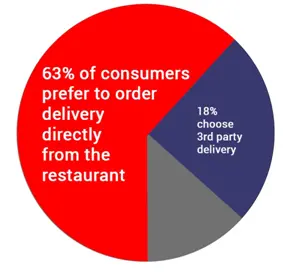
Third-party apps still dominate discovery. Direct online ordering is growing as operators focus on protecting margins. Branded apps are becoming more common for chains. Some restaurants are even running hybrid logistics models, mixing in-house drivers with marketplace support.
There is no single winning model.
The restaurants seeing steady growth are not choosing one channel over another. They are managing all of them with intention. With an omnichannel approach. Marketplace for reach. Direct for profitability. Loyalty to bring customers back.
It requires more coordination, but it also creates more control.
Technology Is Doing the Heavy Lifting
At current order volumes, restaurant food delivery would be chaotic without modern operational technology.
Kitchen display systems now consolidate tickets from multiple sources. AI powered routing tools help determine order priority. Dispatch systems reduce delivery timing errors. Forecasting tools anticipate rush periods based on past patterns.
Without these systems, the friction would be overwhelming.
The interesting part is that most of this technology operates quietly. Customers rarely see it. But they feel it when their food arrives on time and accurate.
That consistency builds trust. And trust builds repeat orders.
Restaurants Are Physically Adapting
A smart food delivery setup is no longer an afterthought in kitchen design.
In 2026, you will see separate prep lines dedicated to digital orders. You will see menus engineered specifically for travel durability. Packaging has improved significantly because presentation still matters, even at home.
Some operators are expanding via ghost kitchens to reach new delivery zones without opening full dining rooms.
Others are redesigning labor models around digital peaks instead of traditional dine-in rushes.
It is subtle, but the operational mindset has shifted.
Profitability Still Requires Strategy
Growth does not automatically equal profit.
Commission fees remain significant for restaurants heavily reliant on third-party platforms. Packaging costs have increased. Labor coordination across channels adds complexity.
That said, operators are adapting.
More restaurants are actively promoting direct ordering through loyalty incentives. Some are adjusting menu pricing specifically for delivery channels. Others are using data to refine prep times and reduce waste.
There is more discipline in 2026. Less experimentation. More optimization.
Why Is This Growth Not Slowing?
Several factors suggest restaurant food delivery is not heading toward contraction.
Hybrid work schedules keep weekday demand steady. Urban density supports fast delivery times. Subscription models encourage repeat behavior. Consumer expectations around convenience continue rising, not declining.
Perhaps most importantly, delivery no longer feels new. It feels normal.
And when behavior becomes normal, it becomes durable.
The Real Opportunity Now
The growth phase of restaurant food delivery is no longer about entry. Most restaurants are already participating.
The opportunity now is refinement.
Smarter channel balance. Better cost control. Technology integration that reduces friction. Clear data analysis by channel.
Delivery has reached a scale where it shapes kitchen design, staffing models, and even brand positioning.
It is not unstoppable because of hype. It is unstoppable because it has embedded itself into daily routines.
Restaurants that treat it as a core strategy, not a side operation, will be the ones capturing the next layer of growth.