
By 2026, the kitchen display system has moved firmly into the category of essential restaurant technology infrastructure. It supports speed, accuracy, and operational control at a time when kitchens are under constant pressure from higher order volumes, tighter delivery timelines, and labor shortages.
The kitchen display system technology, what started just as a digital replacement for paper tickets, has now evolved into a central execution layer for modern food operations.
Global Market Outlook and Growth Trends
Market research by Market Research Future shows strong and sustained growth for the kitchen display system industry. The market is projected to grow from USD 128.36 billion in 2025 to USD 416.92 billion by 2035, driven by a compound annual growth rate of 12.5 percent.
And the growth is not limited to one restaurant type. Quick service restaurants, bars, fast casual brands, cloud kitchens, fine-dining operators and multi-location chains are all are the primary adopters. Even independent restaurants are increasingly following as costs come down and systems become easier to implement.
North America continues to lead adoption due to early POS digitization and strong delivery demand. Europe follows closely, especially in urban markets. Asia Pacific is expected to show the fastest growth through 2026 as food delivery usage and digital restaurant infrastructure expand rapidly.
The Rise of AI-Powered Kitchen Display Systems
Just like every other tech-based industry, the implementation of artificial intelligence is starting to pick up pace in kitchen display systems technology as restaurants move into 2026.
AI-powered KDS software are going beyond just showing orders by actively analyzing kitchen conditions in real time. These systems can adjust order routing based on station workload, predict preparation delays, and suggest pacing changes to prevent bottlenecks during rush hours.
Visual recipe guidance, portion prompts, and dynamic prep instructions help reduce training time and minimize errors, especially in high staff turnover environments.
AI-driven forecasting also allows kitchens to estimate realistic fulfillment and delivery promise times per order, rather than relying on fixed averages.
Over time, these systems learn from past performance, helping restaurants fine tune staffing, menu complexity, and kitchen layouts. As labor costs rise and order channels multiply, AI kitchen display solutions will become a more practical necessity rather than a new concept.
Role of KDS in Multi-Location and Franchise Operations
Market reports highlight strong demand from multi-unit restaurant groups. Centralized visibility is one of the main drivers of KDS adoption.
In 2026, operators expect to monitor kitchen performance across locations without interfering with local workflows. Standardized preparation logic, consistent timing benchmarks, unified reporting, and centralized menu management help brands maintain quality while scaling.
This is especially important for franchises, where operational consistency directly impacts brand reputation.
Delivery Driven Kitchens and Timing Accuracy
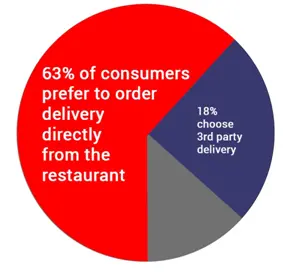
Food delivery continues to account for a significant portion of restaurant revenue. Research shows that delivery-focused kitchens place a higher value on timing accuracy than dine-in-only operations.
Modern kitchen display systems support this by coordinating prep completion with dispatch timing. Orders are paced so food is finished when drivers arrive, reducing hold times and remakes.
This capability has become critical as customers expect restaurant quality food even when ordering remotely.
What the Market Indicates for 2026 and Beyond?
Industry research consistently points to one conclusion. Restaurants that invest in digital kitchen infrastructure outperform those that rely on manual coordination.
The kitchen display system is no longer just a screen. It is a control layer that connects ordering, preparation, and delivery into a single operational flow.
As competition increases and margins tighten, restaurants that delay adoption risk falling behind on speed, accuracy, and customer satisfaction.
Why Paper Ticket System Declined Prominently?
The transition away from paper tickets began around 2010 to 2012, mainly in high volume chain restaurants in the United States. At the time, POS systems were becoming more reliable, and kitchens needed better visibility as menus grew more complex.
The real breaking point for paper systems came after 2015, when in-house online ordering and third-party delivery platforms scaled aggressively. Paper tickets could not handle frequent order updates, modifiers, split orders, or timing coordination with delivery drivers.
By the early 2020s, kitchens relying on paper faced higher error rates, slower prep times, and poor visibility during rush periods. By 2026, paper based workflows are widely viewed as operational risks rather than cost savers.
Final Takeaway
In 2026, the kitchen display system stands at the center of modern restaurant operations. Market data shows rapid adoption, strong global growth, and expanding capabilities driven by delivery demand and operational complexity.
For restaurants focused on efficiency and scalability, investing in the right kitchen display system is no longer a future decision. It is a present requirement.
Curious how next-gen kitchen display systems handle real kitchen pressure in 2026?
Get a live walkthrough and see how it changes kitchen operates behind the scenes.