

When most people think about a restaurant, their mind jumps to the part they can see: a host smiling at the door, waiters moving between tables, or the vibe of the dining room. But that’s just the surface. The heavy lifting, the place where the chaos and magic mix together, happens in the back of house (BOH).
If the front of house is the stage, the BOH (back of house) is the backstage. And without it, the curtain never goes up.
What Does BOH Mean in a Restaurant?
BOH stands for “back of house.” It includes the kitchen, storage rooms, prep counters, staff room, and the administrative area. This is where food is made, dishes get washed, supplies are tracked, and executive decisons are made.
Think of the BOH like the engine under a car hood. You don’t usually look at it, but it’s where all the important work happens.
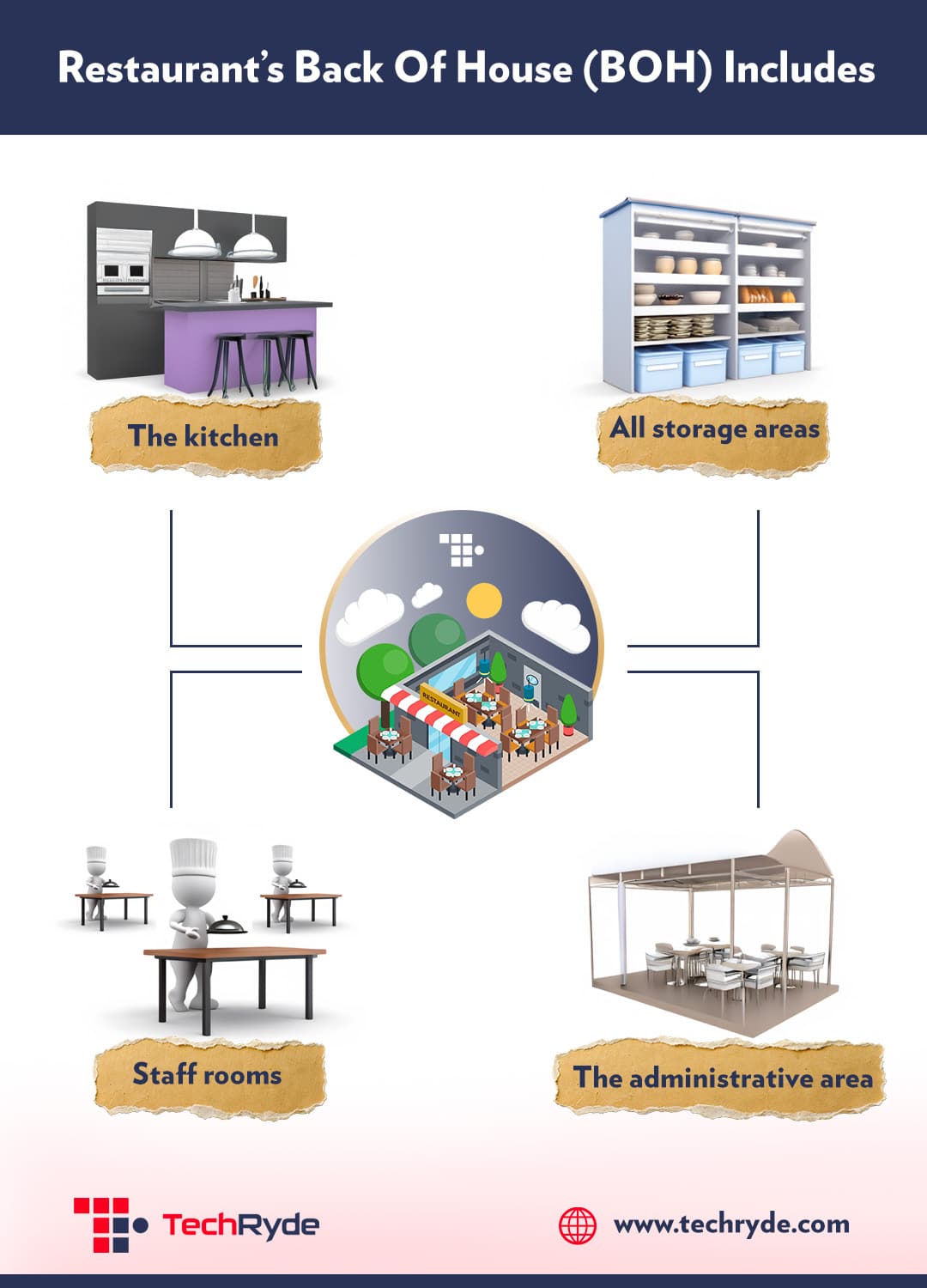
Infographic by TechRyde outlining what the Back Of House (BOH) in a restaurant includes: the kitchen, storage areas, staff rooms, and administrative area
What Are the Key Roles in the Back of House of a Restaurant?
A restaurant’s BOH is made up of people who wear different hats but all push toward the same outcome: food going out on time and at the right standard.
- Head Chef – This is the boss of the kitchen. They’re the ones making sure every dish looks and tastes the same, managing a team that sometimes feels like it’s on the verge of mutiny, and stepping in to fix fires (literal or not).
- Line Cooks and Prep Cooks – The real grinders. Line cooks work in specific stations: the grill, fryers, sauté pans, etc. They’re the ones in the trenches during service, cranking out plates under pressure and keeping cool when orders are flying in faster than they can be fired.
- Dishwashers – These folks are an essential part of the kitchen. Without clean pans, knives, and plates constantly being turned over, everything will stop. When dishwashing lags, it drags the whole kitchen down.
- Inventory and Receiving Staff – Not the most glamorous role, they keep track of what’s coming in, what’s low, and what needs to be re-stocked, so you don’t end up tossing half your stock. A missed delivery or a spoiled box of produce can wreck service before it starts.
- BOH Manager – They oversee schedules, coordinate supplies, and make sure safety rules aren’t just written in a binder. They’re balancing budgets, smoothing out conflicts, and keeping both the chef and ownership happy.
BOH vs FOH: What’s the Difference?
FOH (front of house) is the face of the restaurant. BOH (back of house) is the backbone.
FOH is the smile, the handshake, the perfect plate hitting the table. BOH is the hard work that makes that possible: cooking, prepping, scrubbing, stocking.
They’re different, but they don’t work in isolation. When communication breaks down between the two, chaos is inevitable. Orders get missed, guests wait too long, or dishes go out wrong.
That’s why it’s the new norm for restaurants to lean on tech like smart kitchen display systems (KDS) that replace the old paper tickets and shouting across the kitchen, establishing seamless communication. A KDS gives both FOH and BOH the same information in real time, which can mean the difference between smooth service and a meltdown.
Why is the Smooth Functioning of BOH Critical to A Restaurant’s Success?
- Consistency – Dishes look and taste the same every single night, only because of BOH discipline. This is crucial for maintaining a good reputation and attracting recurring guests.
- Hygiene & Safety – A spotless kitchen is never optional. Health inspectors and guest trust both depend on it.
- Managing Volume – On a busy Friday night, the BOH is either a well-oiled machine or a disaster zone. How well they handle the rush shapes the guest’s experience.
- Support for FOH – Servers can’t serve food that isn’t ready or isn’t cooked right. If BOH stumbles, FOH takes the heat with the customer.
So yeah, the back may be invisible, but it’s never even close to a 2nd priority.
Role of Restaurant Automation in the BOH (Back of House)
For decades, BOH work was just long hours, manual tracking, and a lot of yelling across the line. Today, it looks different. Restaurant automation systems have started to seep into the kitchen, and it’s changing how things flow.
- Kitchen Display Systems (KDS): Goodbye paper tickets. Orders show up directly on a digital screen, color-coded and sequenced, so staff can see exactly what needs to be done.
- Inventory Management Software: No more guessing if you’re running low on tomatoes. Smart tools track usage, predict needs, and even auto-order.
- Third-Party Delivery Integration: Orders from apps like Uber Eats don’t need to be typed in by hand anymore. Automation pushes them straight into the system.
What Are the Common Challenges in A Restaurant BOH?
High Staff Turnover – Constantly training new employees makes it hard to stay consistent.
Poor Communication – Breakdowns between FOH and BOH, or between stations, slow everything down.
Food Waste – Bad inventory control or sloppy prep leads to lost money.
Burnout – Long shifts and heavy workloads cause fatigue and slow TAT.
The Future of Back of House (BOH) Operations
The back of house is on the edge of a transformation.
- AI tools will forecast busy periods so managers know when to schedule more staff.
- Robotics are already showing up, automated fryers, burger flippers, even salad stations.
- Smarter KDS systems will start sequencing orders intelligently, factoring in prep time and kitchen load.
For restaurants that adopt these tools early, the payoff will be smoother service, lower costs, and less staff burnout.
Takeaway
The back of house (BOH) might be invisible to diners, but it’s the heartbeat of every restaurant. If it runs smoothly, everything else, service, experience, reputation, falls into place. With tools like kitchen display systems and broader restaurant automation, kitchens don’t just survive the chaos anymore; they can actually control it. And in an industry where margins are razor-thin, that edge is priceless.
Need help streamlining your BOH operations?
Contact us today to see how we can make your kitchen run smoothly and more profitably.