
If you’re running a restaurant today, you already know that online ordering apps are no longer just a “nice-to-have.” it’s a essential. The question is, should you rely on popular platforms like DoorDash, Uber Eats, or Grubhub — or build your own 1st‑party online food ordering platform?
Both options get food to your customers. But how they impact your profits, customer relationships, and brand control are two very different stories.
Let’s break it down in simple terms.
What’s the real difference?
When someone orders directly through your 1st‑party online food ordering app or website, you own the entire process. You see who your customer is, you set the menu pricing, and you control the delivery.
When someone orders through 3rd‑party online food ordering apps, you’re listed alongside dozens of competitors. They take care of marketing and delivery logistics, but they also take a big slice of your revenue — sometimes 20% to 30% per order.
Why restaurants are moving toward 1st‑party?
Here’s what happens when restaurants choose their own system for online food order instead of only relying on aggregators:
- They save 30–70% on commission fees. That’s money back in your pocket instead of paying the middleman.
- Customers spend more. Studies show people order 25–35% more when they’re in a brand’s own ecosystem rather than a crowded third-party marketplace.
- They own the data. You’ll finally know who your most loyal customers are and what they like to order.
- Better customer experience. When something goes wrong with a 3rd-party order, you take the blame even if it wasn’t your fault. Direct ordering avoids that mess.
But 3rd‑party apps still have a role. .
This doesn’t mean you should completely ditch 3rd‑party online food ordering apps. They’re great for discoverability—new customers who might not know you yet are more likely to find you there. Plus, they handle the logistics when you’re short on staff or resources.
In short, 3rd‑party apps can bring in the volume. But your own 1st‑party online food ordering app brings in profit and loyalty.
What the numbers say. . .
- 57% prefer takeout or delivery over dine-in because of convenience.
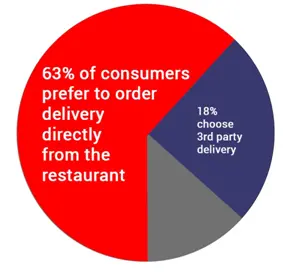
- Around 40% of customers actually prefer ordering directly from a restaurant’s site or app when given the choice.
And here’s the kicker: mobile is king. Over 80% of all food delivery orders come from a phone. If you don’t have a seamless mobile-friendly ordering experience, you’re leaving money on the table.
The smartest approach? A hybrid strategy
Many successful restaurants use both. They stay on 3rd‑party online ordering apps to stay visible but gently push customers toward their own channels with:
- App-only discounts and loyalty perks
- QR codes on packaging that say, “Next time, order direct!”
- Freebies for first-time direct app users
This way, you get the best of both worlds—new customers and higher profit margins.
A quick reality check
Think about it:
- On a $50 order, a 3rd-party app might take $10–$15 in fees.
- On that same $50 order through your own app for online food order, you keep almost the full amount.
Multiply that over hundreds of orders a week. The math speaks for itself.
Final word
3rd-party platforms like Uber Eats and DoorDash aren’t going anywhere, and they do have their place. But relying only on them means giving up control, customer relationships, and a chunk of your profits.
Owning a 1st‑party online food ordering app doesn’t just save money. It builds loyalty, improves the customer experience, and future‑proofs your restaurant in a digital-first world.
So yes, stay on the big apps for visibility—but start moving your loyal customers toward your own channels if you really want to grow sustainably.